Indication of project duration: 100%

Last modification: 28.1.2008
© Thritton
|
 |
Mixture identification - picture gallery
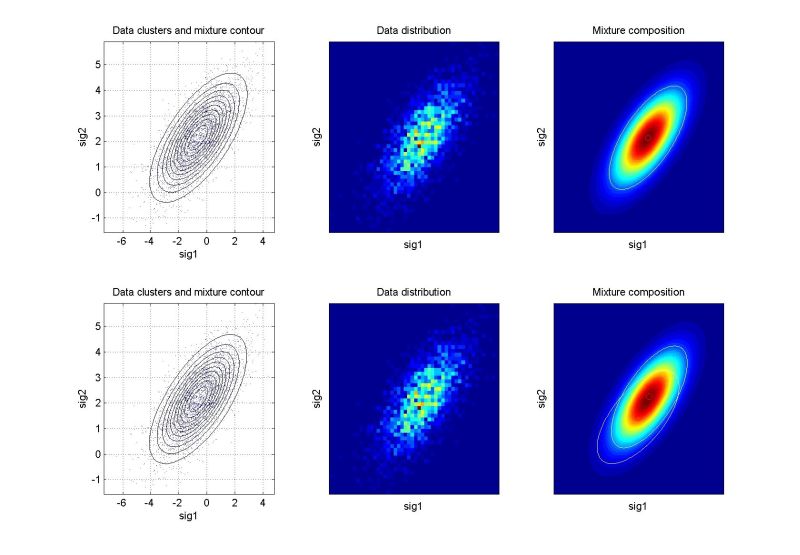
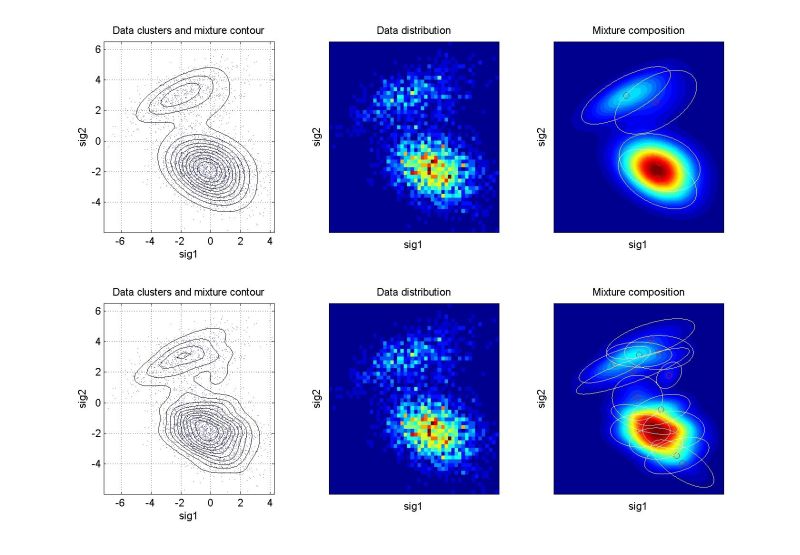
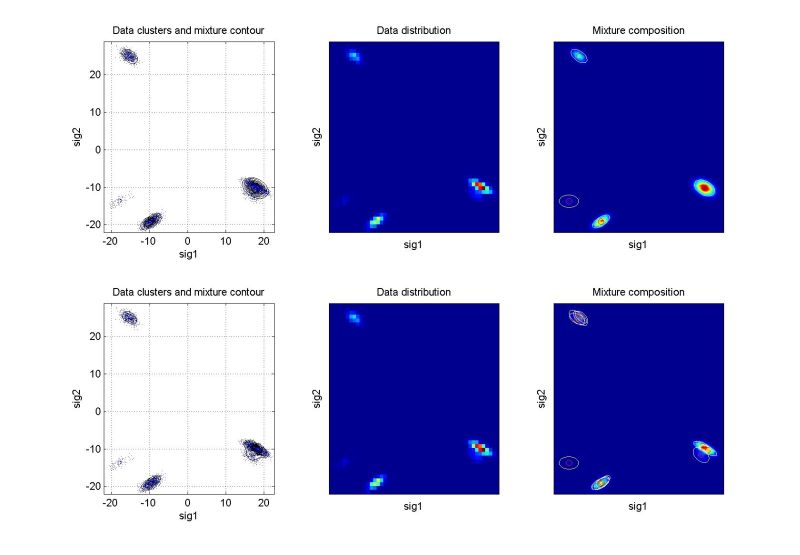
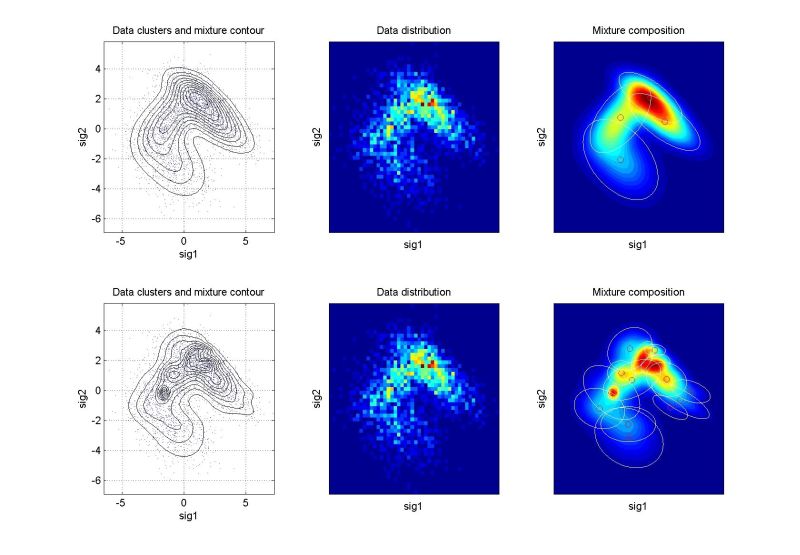
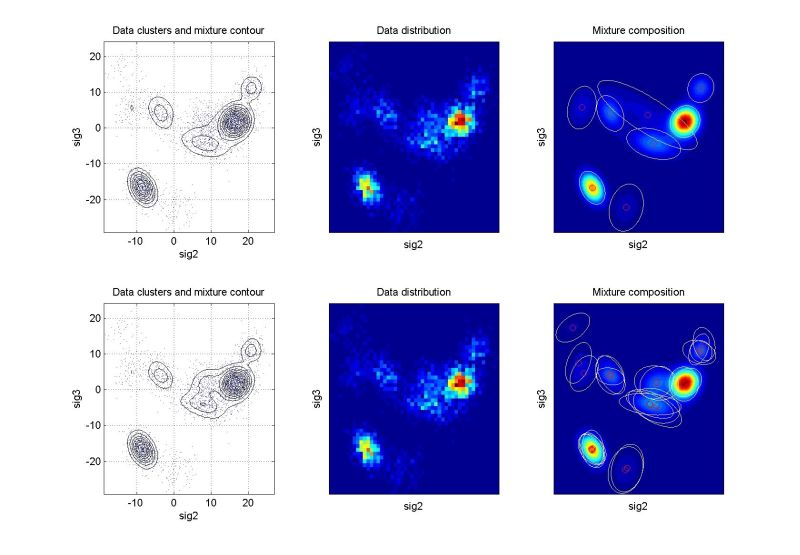
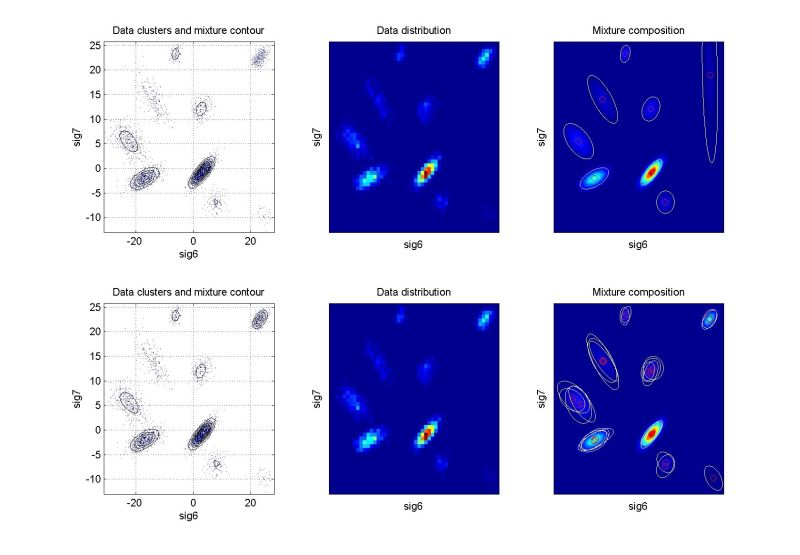
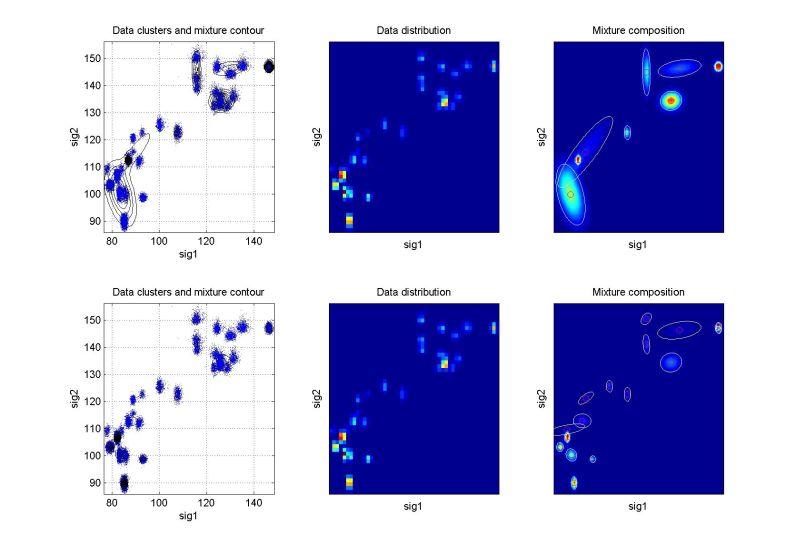
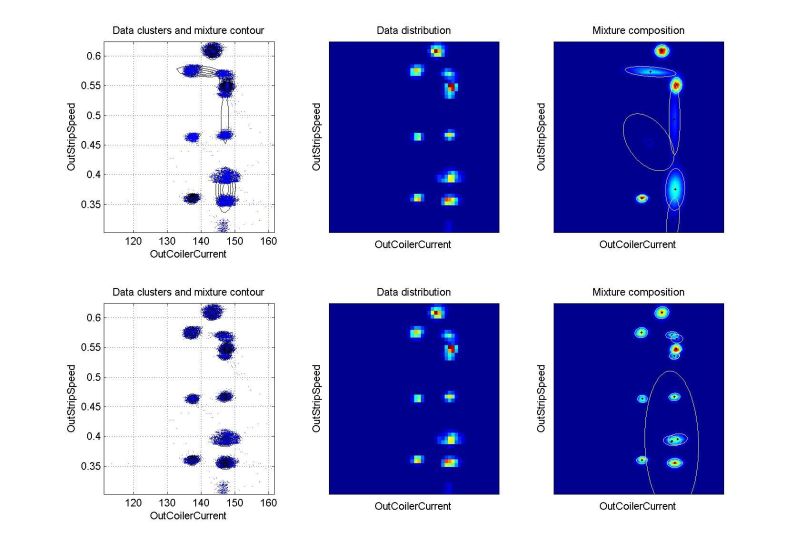
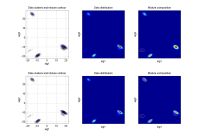
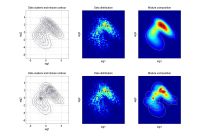
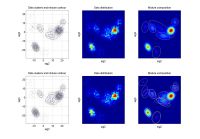
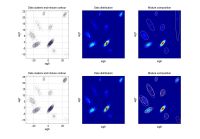
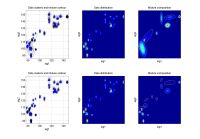
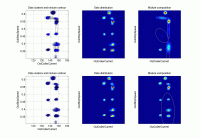
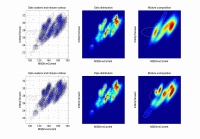
Plot rows in the following pictures correspond to the first or second
identification runs respectively. Particular left plot shows data
distribution and contour of the identified mixture. Middle plot depicts
two-dimensional histogram of relative data frequency (empirical
probability distribution) - the mixture should be similar to it.
Right plot shows mixture composition. Two-dimensional projections are
used for multidimensional cases.
Further criteria for evaluation of identification quality are based
on comparison of calculated estimation likelihood and – for dynamic
mixtures – on evaluation of prediction errors. Further information
are or will be available on Links and articles page.
Meaning of identifiers in following tables: ndat - number of data
samples, ndim – number of data channels (dimensions), ncom – number of
components for simulating mixtures.
It is stated for multidimensional mixtures (ndim > 2) which
dimensions are used for a 2-D projection.
Click on a plot to enlarge a picture.
Simulated data – static mixtures
Experiments with simulated data are advantageous for basic testing of
algorithms as there is known “what should come out”.
| Simulated data –
static mixtures |
 |
 |
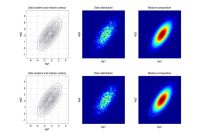
ndat=3000, ndim=2, ncom=1
The simplest case, the simulating mixture was composed by a single component. Identified well, the 2nd run does not bring anything new. |
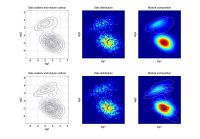
ndat=3000, ndim=2, ncom=2
The simulating mixture created by 2 adjacent components. The mixture from the 2nd run has too much components. |
 |
 |
ndat=3000, ndim=2, ncom=5
The simulating mixture created by 5 isolated components. Good identification, 2nd run slightly better. |
ndat=3000, ndim=2, ncom=5
The simulating mixture created by 5 adjacent components. The mixture from the 2nd run has too much components. |
 |
 |
ndat=3000, ndim=9, ncom=9, projection 2-3
The simulating mixture created by 9 isolated components. Good identification, 2nd run slightly better. More components then necessary after the 2nd run. |
ndat=3000, ndim=9, ncom=9, projection 6-7
Another projection of the foregoing mixture. |
Simulated data – dynamic mixtures
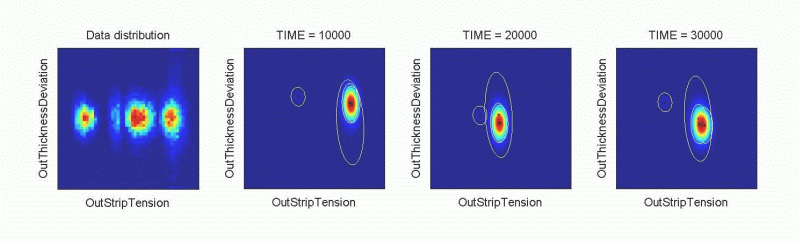
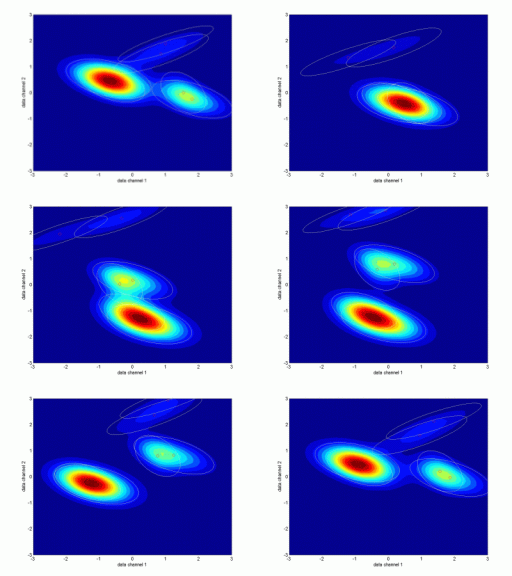
Chronological succession of samples plays a key role for a dynamic mixture.
Therefore the particular data sample must be given for the mixture projection.
Dynamic mixtures are used for n-step ahead predictions.
Following picture shows an example of a dynamic mixture, which was
identified from simulated data with the first order dynamics. Current
data point moves around a circle for illustration.
Real data
| Real data – static mixtures |
 |
 |
ndat=30000, ndim=2
Rolling mill data: values of electric currents for separated passes make isolated data clusters. 2nd run brings significant improvement. |
ndat=30000, ndim=10
Rolling mill data: electric current of the output coiler drive against output strip speed. Vertical arrangement of data clusters made by simple distribution of the 1st signal channel. Good result. |
 |
|
ndat=30000, ndim=10
Rolling mill data: electric current of the main mill drive against output strip tension. Good result. |
|
| Real data – dynamic mixtures |
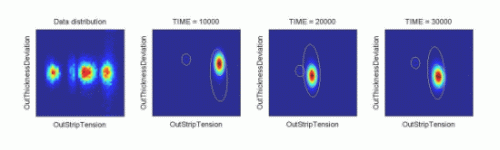 |
ndat=30000, ndim=10
Dynamic mixturesRolling mill data: projection of output strip tension against output strip thickness deviation. Empirical data distribution on the left plot followed by three projections for different values of time. |
|